
On a June day in New Bedford’s Rural Cemetery, volunteers from the city’s Civil War Round Table walked among the graves of men who fought in the Civil War and their families, assessing the condition of burial sites and planning how to restore and preserve them.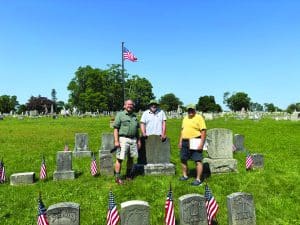
They were documenting the condition of each headstone, mindful not to cause further damage. It’s painstaking work, with about 300 Civil War-related grave stones to be restored, but for the CWRT, it’s a meaningful endeavor.
Each of the stones is part of a plot purchased by the city’s William Logan Rodman Post Number 1, the first Massachusetts chapter of the Grand Army of the Republic, a postwar veteran’s organization much like today’s VFW or American Legion.
Sadly, many are in danger of being lost due to time and weather. Some graves have already become unreadable, one of the reasons the CWRT is stepping in, according to the organization’s president Mark Mello, a historian who understands the value of preserving the city’s history.
“Many of these graves are falling apart and need careful attention,” Mello said via email. “Many of the oldest graves are extremely moss-covered and weather-worn. Some of the stones have fallen over or are severely leaning.”
The stones tell stories spanning nearly a century, from 1870 through the 1960s, when a granddaughter of a Civil War veteran was buried in the plot.
To restore the markers, the CWRT will use D2 Biological Solution, an environmentally safe cleaner approved by the federal government. On the dirtiest stones, they’ll also gently scrub with soft brushes. They are receiving assistance from the Sons of Union Veterans, a group of descendants of Civil War soldiers, who are providing the expensive D2 solution, tripods, and other tools to help reset fallen stones.
“Cemeteries are one of the richest places to learn about those who have come before,” Mello said. “A simple stone can uncover a life lost to history. Even something as simple as a name and dates of life can be a clue to put a historian on the case of the life of a common person lost.”
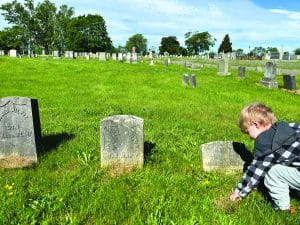 He points to the lives of individual veterans whose stories might otherwise be forgotten. Manuel Antone (1833–1920), a Cape Verdean fisherman, served in the U.S. Navy from 1862 to 1864. After returning home, he married Amey, worked in the whaling industry for decades, and fought for 20 years to receive a pension for his service-related disability.
John R. Kincade, the son of Irish immigrants, enlisted in 1864 at 21, survived brutal battles with the 58th Massachusetts Regiment, and was imprisoned in Richmond, Va., before being discharged due to poor health. After the war, he worked as a grocer on Elm Street in New Bedford until dying at age 32 from complications related to his injuries.
“These are not the famous generals or leaders of the war,” Mello said. “These are the men who fought, and the families who stayed behind and struggled in the absence of their loved ones. You won’t read these stories in books. One of the best ways to keep their stories alive is to preserve the simple stones that mark the resting place of those individuals’ earthly remains.”
The CWRT welcomes volunteers and those who enjoy hearing military history. Meetings are held on the fourth Tuesday of each month from September through June at the Low Tide Yacht Club at Fort Taber.
Those interested in helping with the Rural Cemetery project can email newbedfordcwrt@gmail.com for details. Planned workdays in October and November will include spraying, light cleaning, and resetting damaged headstones. Materials and instruction will be supplied.
Recent Comments