
When Jim Barrington headed south from Dartmouth to North Carolina, he expected a long day, but not a grueling test of endurance.
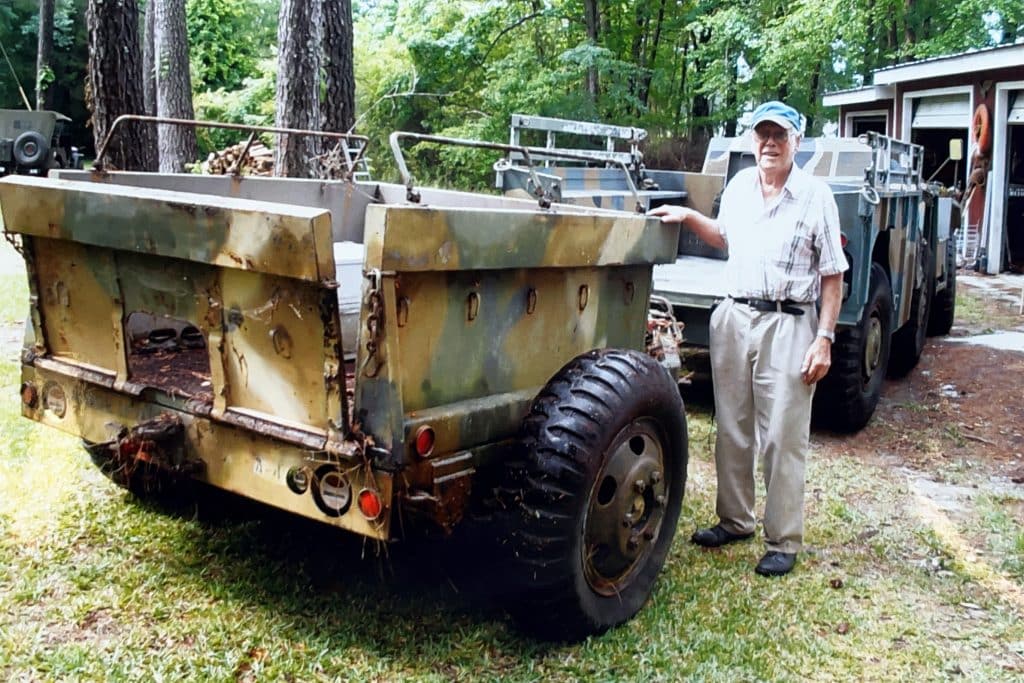
The goal was simple enough: retrieve a surplus military command car from his parents’ former property and bring it home.
The reality was very different.
Barrington, 73, left New Bedford after finishing work one May evening, driving straight through the night, about 800 miles, with a trailer rated to handle the weight and a winch system he believed would do the job.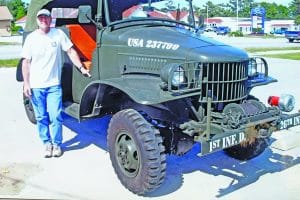
The plan was to arrive early, load the 2.5-ton vehicle, grab a quick bite, and head back north. He intended to return later for three other military vehicles stored on the property.
What pushed him to act quickly was what he’d recently learned about the site itself. After the death of his sister several years earlier, the family home had been abandoned, something Barrington only discovered when a developer called to ask about purchasing the land.
“I was told, ‘It’s abandoned,’” Barrington said. “That’s when I knew I had to go.”
When he arrived early the next morning, he barely recognized the place. Overgrown grass and young the house and garage were nearly hidden. Barrington spent hours just clearing a path wide enough to get his truck and trailer close to the garage.
The command car, the first vehicle he wanted to bring home, sat inside. It was the one Barrington cared about most. Getting it onto the trailer, he thought, would take an hour.
Instead, it took most of the day.
Barrington backed the trailer into position and hooked his hand winches to the front of the vehicle. Nothing moved. The reason became clear quickly: the wheels were frozen with rust.
“I can’t move that vehicle, not even an inch,” he said. “And I’m sitting there thinking, ‘Oh my God.’”
Working alone in the humidity and heat, Barrington jacked up the front end and removed the tires.
“I had a big crowbar and I put it in the studs and so I stand on it and I stand on it and I get it to move a little bit and I go on the other side and stand on it.”
Barrington went back and forth on each side, forcing each wheel to turn, a few inches at a time, until they finally broke free. He repeated the process on all four wheels. By the time he finished, four hours had passed.
It was now mid-afternoon, the temperature was high, and Barrington had little food or water. He was soaked in sweat and exhausted, and he still hadn’t gotten the vehicle up the ramps.
 He reattached the winches and started pulling the command car forward. It moved, slowly, but stalled halfway up the ramp. No matter how hard he pulled, it wouldn’t go.
That’s when experience kicked in.
Instead of pulling straight ahead, Barrington rerouted the winch straps over the tires and hooked them underneath. That way, the force rotated the wheels rather than dragging the vehicle.
“An inch on this one, an inch on that one, then an inch on this one. I can roll that truck up that ramp one wheel at a time,” he said.
Hours later, the command car was finally on the trailer.
Hungry, drained, and relieved, Barrington climbed into his truck to leave and promptly got stuck.
While backing up earlier to get a better angle, the truck’s tires had sunk into a rut. Now they just spun.
For two more hours, Barrington tried everything he had: jacking up the truck, stuffing two-by-fours under the tires, crawling through dirt beneath the frame. Nothing worked.
“I was done,” he said about his emotional state in that moment. “I had nothing left.”
Barrington walked to the road and flagged down passing vehicles. The second person to stop happened to know the family. She called her husband, who worked at a neighboring farm, and he arrived with a four-wheel-drive pickup and towed Barrington free.
Once out, Barrington drove to the farm to check that the trailer was properly balanced, critical to prevent fishtailing on the highway. There, he was handed a Gatorade, a muffin, and a hose to rinse off in the greenhouse.
“It saved my life,” he said.
Already dark, he chose to spend the night sleeping in the truck. At dawn, he hit the road for home.
The command car was the first of four military vehicles Barrington would bring home over the next several months. The others, all 1942 weapons carriers, were heavier but, thankfully, not quite as difficult to retrieve.
On his second trip, Barrington brought his son with him, who helped continue a family tradition that stretches back decades.
Barrington’s father, William David Barrington, was a longtime restorer of military surplus vehicles, often buying multiple damaged ones to rebuild a single working model. As a boy, Barrington learned by taking them apart.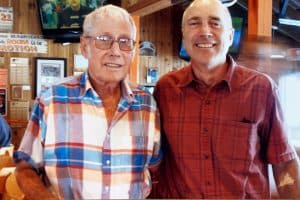
“He’d hand us wrenches and tell us to take off every nut and bolt,” Barrington said. “My brother and I would spend hours doing it.”
Barrington senior was a veteran who served in the Marine Corps in World War II. He had been working on airplanes as a civilian but when his younger brother was killed at Guadalcanal, he enlisted.
“After boot camp, they said to him, ‘Well, what can you do?’ And he said, ‘I work on airplanes.’ So they put them on an aircraft carrier,” Barrington said.
Troubleshooting and restoring military equipment to working order was in his bones, and a love he never lost. Right up to his death in 2017 at age 94, he was passionate about and protective of his vehicles and tools.
For Barrington, work with his father continued after his dad retired to North Carolina from Massachusetts.
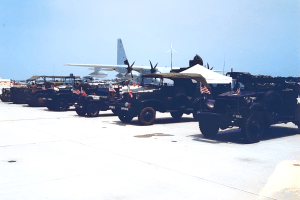
Together, they added to the collection and brought the vehicles to parades as well as air shows at Marine Corps Air Station Cherry Point in North Carolina, sometimes traveling with a convoy of nearly a dozen restored vehicles.
Keeping the vehicles running and in the family matters.
“They have to be running because to let them sit there is a waste of his effort,” Barrington said about his dad. “It’s like a memorial to him.”
Each of the four vehicles Barrington transported to Massachusetts and a fifth, a jeep that he already had at home, were restored by his father.
One of the vehicles will eventually go to his son, Barrington said, continuing a line that now includes four generations of William David Barringtons.
Barrington hopes to keep sharing the vehicles with the community as well, bringing them to local parades and even using them for everyday errands.
When he does, people often leave him notes on the windshield.
“My father was in World War II,” they write. “He drove one of these.”
Barrington reads and enjoys everyone one of them.
Recent Comments