
It may not have been the biggest crowd, but there were no bigger hearts anywhere.
People gathered Oct. 8 in New Bedford to offer support and direction for those facing mental health challenges.
Most were outreach workers in mental health or recovery support, there to share their experiences, honor those lost to mental illness or suicide, and celebrate the achievements of people who have turned their struggles into purpose.
The candlelight vigil, organized by the Bristol County chapter of the National Alliance on Mental Illness and led by chapter president Brenda Venice, marked Mental Health Awareness Week (Oct. 6–10) and World Mental Health Day (Oct. 10). Its purpose: to remind everyone that it’s okay to talk about mental health.
“The more people talk about it, the better it is,” said Venice. “It’s okay to say I have it. It’s okay to get treatment and be on your way.”
Venice has spent decades helping others, especially parents of adults with mental health challenges, navigate the complex system for assistance and housing. Many, she said, don’t realize help exists or that what their loved one is facing even counts as a mental health struggle. Too often, parents fear what will happen when they’re gone.
“For me…it wasn’t an easy thing, my mother being sick with mental illness. And then I lost a brother at a young age of 28, death by suicide,” she said. “And then I have two adult children with mental illness…So we know what can happen, what it is to have a family member with mental illness.”
Mental health and addiction are intertwined, said Santos Ortega, a recovery coach and outreach coordinator for PAACA, who shares his lived experience with those he helps.
People often turn to substances to numb emotional pain, he said, and recovery can surface the same wounds. “When you’re actively using, your brain’s fooling you and convincing you that the things that you’re doing are okay, are justified,” he said. “And when you get out of that, you start looking in retrospect and you’re like, ‘Oh my God, what was I doing?’”
As healing begins, shame and guilt can take a toll. Ortega, who spent six years in jail, now helps others reach the point where they, too, can say, “I’m never going to do it again.”
He tells those struggling that recovery takes patience and faith. “It’s not that it gets easier, because life is a series of mountains to climb… But what I can say is things get better.”
“Take it slow… and it’s going to get better. As long as you stick it out.”
Belief in something larger is crucial, Ortega says, speaking from experience. “If you want it to be Santa Claus, that’s fine, so long as it’s got that moral pathway for you to follow… But for me, finding God was probably the most important part.”
In his outreach work, Ortega meets people where they are. “People don’t come to us. We go to them… We meet them exactly where they’re at with no opinion, no judgment. We understand because everybody that’s working with me has been there.”
Rev. David Lima, who leads local suicide-prevention efforts, spoke about the lingering stigma around mental health. In his opening prayer, he urged those present to “take care of those (who) have meaning” and asked for strength to change a society where “the shame, the stigma that so many have that they won’t even reach out to help.”
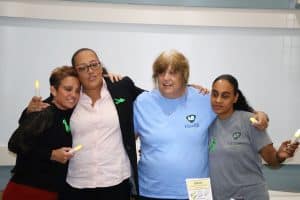 During the vigil, NAMI Bristol County also presented its Hero in the Fight award, honoring those who embody dignity, courage, hope, and recovery. This year’s recipient, Danielle Brown, is project director for the FAHIR program at Steppingstone, a Fall River nonprofit serving people experiencing homelessness and behavioral health challenges.
“Mental health (struggles) have been in my family my whole life. And it’s often silent, right?,” Brown said in her acceptance remarks. “Many people don’t know the battles that we fight… For me, fighting my battle is fighting the battle with those (who are) in our community.”
“This right here means the world to me because I’ve lost family members (to) mental health. I’ve struggled with mental health…and had to overcome my own personal mental health.”
“If I can help one person, that’s all that matters,” Brown said.
Through FAHIR, Brown oversees clinicians, outreach workers, case managers, and housing staff who provide wraparound care. She also helps expand local shelter capacity—last year securing funding for 90 additional overflow beds in collaboration with Catholic Social Services’ Sister Rose House, Rise Up for Homes, and the state. She’s applied again for state funding for this winter, though funding announcements are still pending.
Brown said she sees more older adults struggling with mental health problems and homelessness. “We have a large population (who are) 70-plus that have now gone onto the streets due to their income, the costs rising on housing, and then they become depressed…”
About 60 percent of FAHIR’s service population is now age 55 and older, she said.
Her work has taught her the importance of reframing language around mental health. A lot of individuals say, “‘Well, I don’t have mental health,” she said. “Instead of saying mental health illness, I look at it as individuals who have mental health barriers or disorders…We all have struggles, right?”
Brown’s advocacy has earned her multiple honors, including the Black Excellence on the Hill Award from the Black and Latino Caucus of Massachusetts and the Human Rights Award from the New Bedford Human Rights Commission.
Venice too is alarmed by homelessness, particularly with how many people are discharged from treatment without housing. “There are more people…being discharged with severe mental illness to our city streets and our parks and shelters, and I don’t believe that’s a good fit,” she said. She hopes to work with the governor, local mayors, and developers to pursue a “Housing First” model—safe apartments instead of the streets or shelters.
“If people can’t live by themselves, then let’s get a rest home or something… so they’re not on our city streets.”
Venice said that breaking silence is key. It’s why she dedicates her time to supporting families who struggle with mental health and leads an eight-week, comprehensive Family-to-Family course that helps them understand mental illness, medications, crisis lines, and more. The next session begins in April 2026 in New Bedford. To sign up, email namibristolcounty@comcast.net or call 508-493-9048.
Recent Comments