
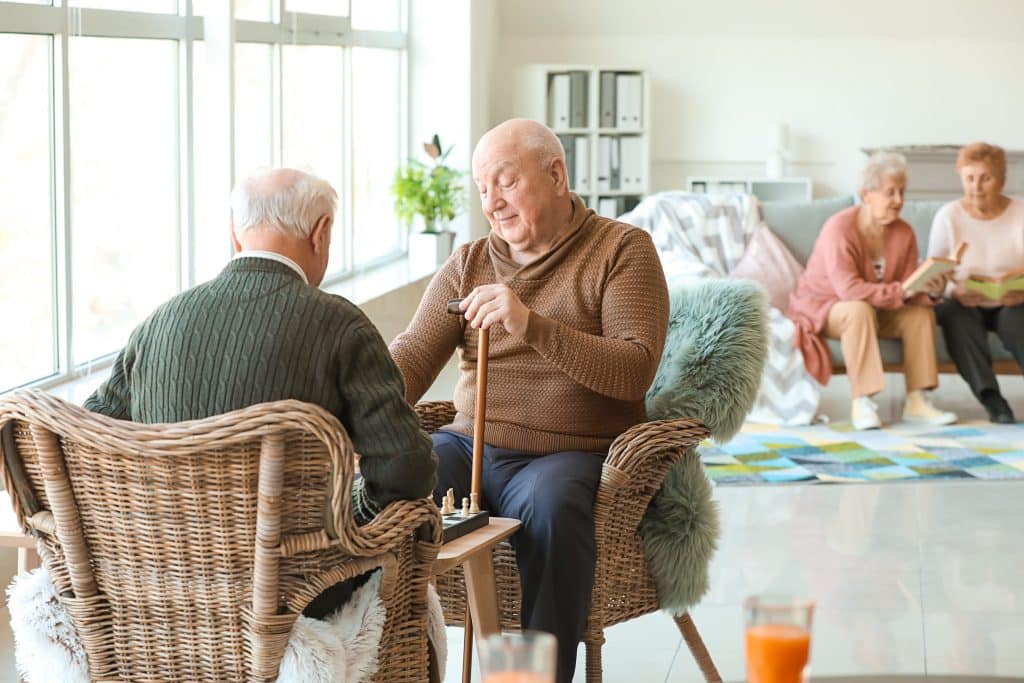
Senior men playing chess in a home-like setting.
Caregiving often starts in small ways. You begin helping your mother with groceries. You drive your father to a few medical appointments. You take over the bills when your spouse becomes ill.
Then the responsibilities multiply. The appointments increase. The paperwork stacks up. And somewhere along the way, without ever applying for the job, you become a caregiver.
Across the country, aging leaders are working to better recognize and support the nation’s 63 million caregivers, widely described as the backbone of care in the United States.
The effort builds on a 2022 national caregiving support strategy that was highlighted during a Feb. 5 webinar hosted by the National Academy for State Health Policy, the Administration for Community Living (ACL), part of the U.S. Department of Health and Human Services, and the John A. Hartford Foundation. The session focused on expanding state-level efforts and sharing progress from four leading states, including Massachusetts.
“Caregiving, caregivers…is ACL’s number one priority,” said Mary Lazare, principal deputy administrator for ACL. “They’re the bedrock. They’re the largest group…of care support in this country. And we salute every one of you.”
Lazare issued several challenges to aging services professionals: continue building innovative programs and make sure caregivers can actually find them.
“How do you get that information out to people who are going, ‘I don’t know where to go. I don’t know who to ask?’” she said. “(so it’s) not only developing the resources but getting them into the hands of the people who need them.”
She also urged states to replicate and share successful models nationwide.
One of the biggest barriers, speakers noted, is that many caregivers don’t identify themselves in that role and others are so focused on managing daily crises that they don’t pause to seek help.
Stephanie Gibson, who runs the Family Caregiver Program at Coastline Elderly Services and leads its caregiver support group, sees that every day.
“Here you are taking care of your mom because she’s your mom … your spouse because they’re your spouse,” Gibson said. “Next thing you know, you’re taking on being the homemaker, paying the bills, taking them to medical (appointments) and doing the transportation. You don’t even grasp that you’re a caregiver until somebody says, ‘Hey, you’re a caregiver.’”
Many family caregivers first connect with Coastline through its Home Care department, seeking help for their loved one. When care managers notice a family caregiver struggling, often while trying to provide 24/7 care, they refer them to Gibson.
“You hope somebody knows about Coastline and the Family Caregiver Support Program and can point them in a direction just to talk to somebody and maybe get some ideas or know what’s going on and what’s available to them,” she said.
A key support offered is respite care, which provides a set number of hours each year for in-home assistance from a companion or home health aide, allowing caregivers time for self-care.
Gibson expains how the program works, talking with them about what their needs are and what support they’re looking for.
Respite care is a growing focus nationally. In Maryland, the Department of Aging launched a Respite Ambassador Training Program after hearing repeatedly that respite is essential but difficult to access. Ambassadors are now trained to identify and support caregivers consistently across state systems.
In Massachusetts, officials surveyed agencies to better understand caregivers’ greatest challenges. Caregiver burden, burnout and stress topped the list of responses, followed by financial strain, work-life balance, system complexity and limited awareness of available supports.
State leaders concluded that caregivers “are not struggling because they lack resilience,” according to Molly Evans, Senior Manager, Strategic Programs & Innovation, in the state’s Executive Office of Aging & Independence, who gave the presentation, but because the systems around them are fragmented and hard to access and understand.
Massachusetts has since funded five Family Caregiver Innovation Grants totaling about $400,000 across 91 municipalities.
At the federal level, ACL is also exploring how artificial intelligence might ease caregiver burden.
On Feb. 5, it launched phase one of its Caregiver AI Prize Competition, a national challenge encouraging technology innovators to develop practical tools that deliver on-demand training, monitor well-being and automate documentation, potentially freeing caregivers to focus on the people in their care.
While policy efforts scale up, Gibson continues her work one caregiver at a time.
“I’m grateful to be able to give what I give so they can get the self-care, because that’s the main objective, to make sure they’re taking care of themselves,” she said. “Sometimes you just…keep going, going, going that you miss your own doctor’s appointment. But it shouldn’t be that way.”
For more information about Coastline and its Family Caregiver Program, call 508- 999-6400. For more information on phase one of the Caregiver AI Prize Competition, visit acl.gov/ caregiver-ai-competition.
How do you know if you are a Caregiver?
You may be a caregiver if you:
- Help a family member or friend with medical appointments;
- Manage medications or coordinate care;
- Handle bills, insurance or paperwork;
- Provide transportation;
- Assist with bathing, dressing or meals; or,
- Regularly check in to ensure someone’s safety.
You don’t have to live with the person or provide round-the-clock care to be a caregiver.
If you’re feeling overwhelmed, burned out or unsure where to turn, support may be available.
Contact Coastline at 508-999- 6400 to learn about caregiver resources and respite options. Or, call Stephanie Gibson at 774-510-5209 to join the Caregiver Support Group from 1-2:30 p.m. on the first Thursday of the month at the Dartmouth COA.
Recent Comments