
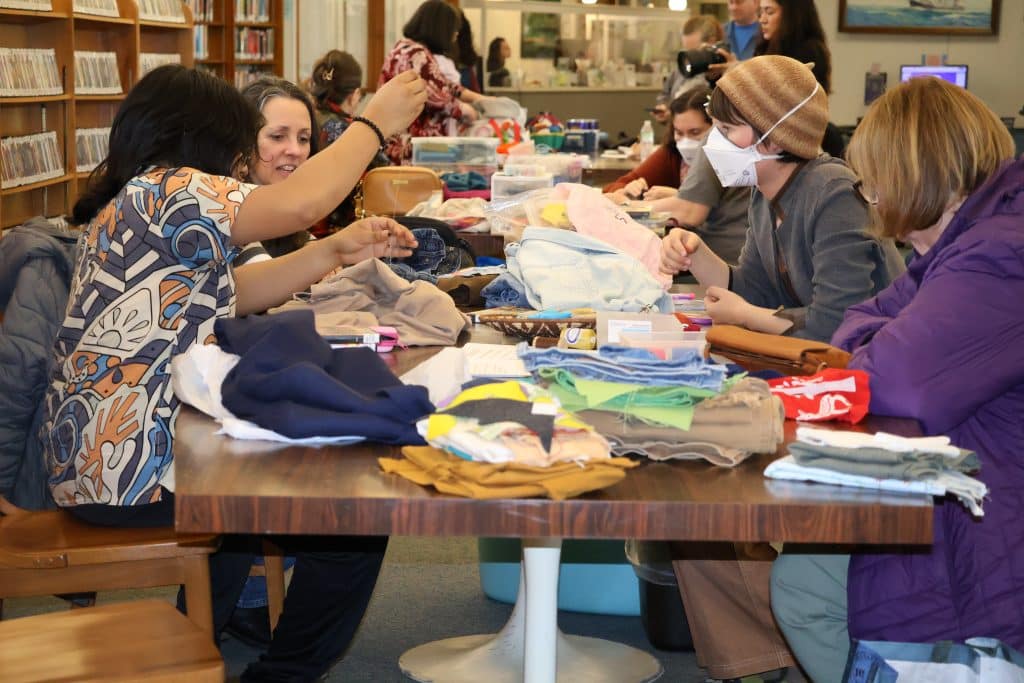
A table covered in thread, fabric, and well-used sewing tools, New Bedford resident Deborah Herrmann waited her turn with a practical question: how to shorten the sleeves of her son’s lined suit jacket.
Herrmann already knew her way around a needle and thread. She learned the basics growing up and has built on them over the years, mending clothes and even restyling them. She once turned her husband’s pullover sweatshirt into a zip-up for easier wear.
“My mother taught me how to darn years ago,” Herrmann said. “I know how to darn. I can put zippers in, and I know how to patch.”
Around her, the Howland Green Library had been transformed into a hands-on workshop, with three stations dedicated to core mending skills. Volunteers showed participants how to darn, patch and repair zippers using slow stitching techniques.
For many, especially the older participants, the event tapped into something familiar. Sewing and mending were once skills passed down routinely from one generation to the next. That tradition has faded in many households, but interest appears to be returning.
The mending event was the first in Fix It Forward: A Workshop Series on Repairing and Reusing, a six-part program from the Greater New Bedford Regional Refuse Management District. The goal is both practical and cultural: to help people fix what they have and rethink what gets thrown away.
 The series is supported in part by the Art is Everywhere! grant funded by the City of New Bedford through its Arts, Culture & Tourism Fund, and is facilitated by New Bedford Creative at the New Bedford Economic Development Council.
The intent is to promote waste reduction in everyday life, said Marissa Perez-Dormitzer, the district’s waste reduction manager.
“When people repair clothing or swap fabric, they extend the life of materials and avoid unnecessary waste,” Perez-Dormitzer said. “With textiles no longer allowed in the trash in Massachusetts, Fix It Forward helps residents turn that policy into every day, doable actions.”
Upcoming sessions will expand beyond textiles, with workshops on bicycle repair, fabric dyeing, knife care, jewelry-making from tableware, jewelry and eyeglass repair, and Japanese mending techniques known as sashiko. All are free and open to the public.
For volunteer Ami Chitwood, the event also reflects a shift in how people learn these skills.
She came to mending on her own, eventually starting South Coast Stitch & Mend Studio in New Bedford. Her mother, she said, failed sewing class.
“It’s a funny family story, but it just was never her purview, and her mother never did it either,” she said. “There are people in my generation who clearly had it passed down to them and it was something that they did in the family. I’m self-taught, although I kind of wish I’d grown up with it.”
Chitwood emphasized that mending doesn’t have to be perfect to be worthwhile.
“If you’ve got something that you like then you shouldn’t throw it out just because it’s got a moth hole in it or it’s got a rip or there’s a seam that’s busted,” she said. “Everybody can do something. It doesn’t have to be as artistic as the experts, it can be functional.”
“I think that there’s a sense of satisfaction of doing something with your hands that solves a problem,” she added. “And I think we just don’t get that opportunity often enough.”
For Herrmann, the appeal was both practical and personal. She didn’t want her son to have to keep rolling up his sleeves.
“I thought, I know how to sew, I should do this. So I just want some advice with the lining and all,” she said, adding, “I think this is wonderful. I came from North New Bedford just to participate.”
The next workshop, A Bicycle Fixed By You, will take place from 10 a.m. to noon on May 9 at the Howland Green Branch Library. Led by Bill Trimble of Youth Opportunities Unlimited, it will focus on troubleshooting common bike problems. Participation is limited to 12, and registration is required.
Also upcoming is the Jewelry Repair 101 workshop on June 6.
For more information on workshops, visit www.gnbrrmdistrict.org. For textile recycling options, see options on page 9 of the May Senior Scope.
Recent Comments